
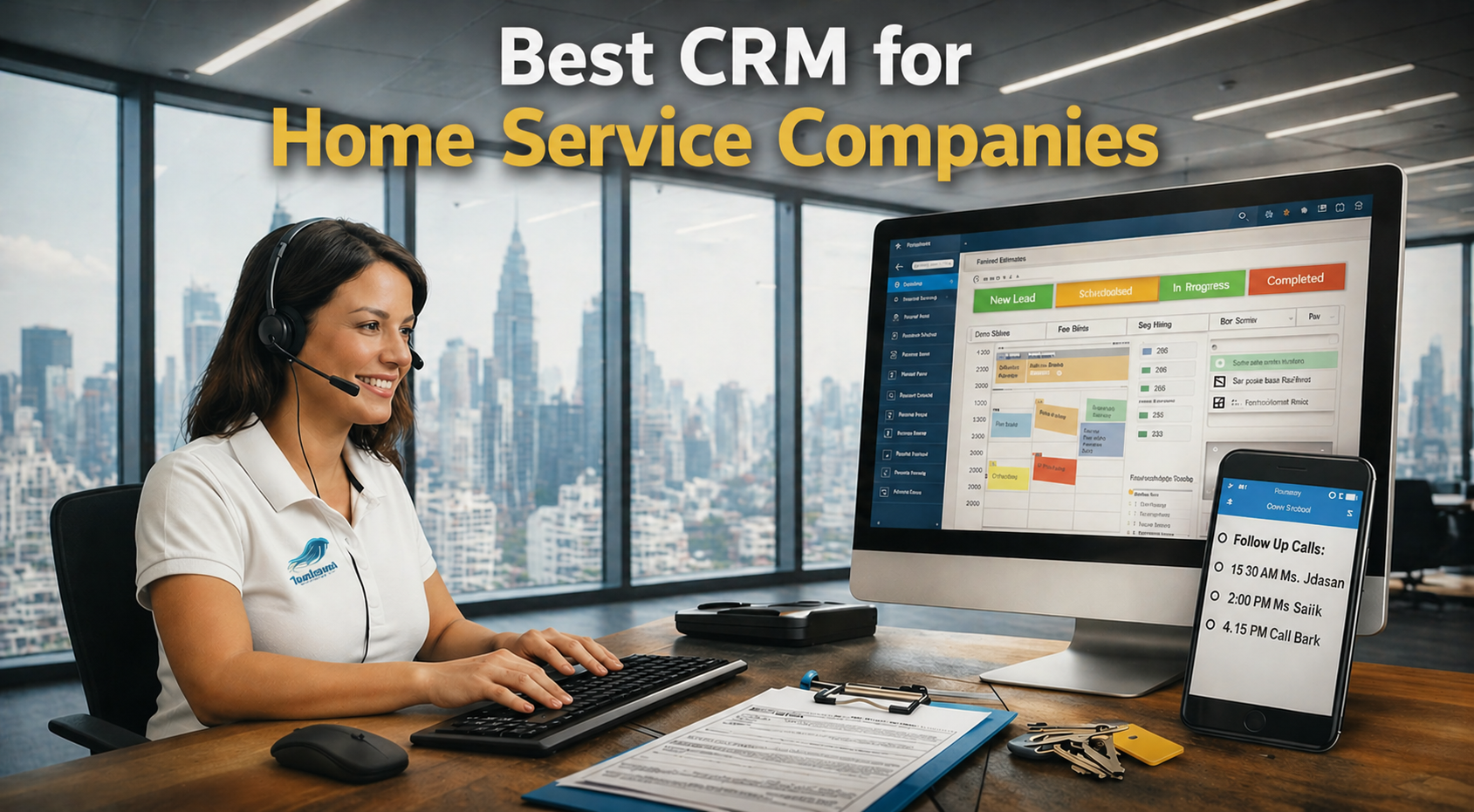
Best CRM for Home Service Companies
The leads are coming in. The jobs are getting booked. But behind the scenes, everything is just a little bit more difficult than it needs to be.
Customer information is scattered.
Follow-ups are being missed.
Dispatch, sales, and communication are no longer happening in one place.
And at some point, the question is asked:
Do we need a CRM? And if we do… which one works?
The issue is that most of what you’ve been told about CRMs just doesn’t apply to home service businesses.
Because running a call center, booking jobs, and dispatching technicians is not like running a traditional sales pipeline.
Why Most CRMs Fail in Home Services
Most of these systems were created for sales-based businesses, not service-based businesses.
They were built for deals, pipelines, and sales cycles, not for answering calls, scheduling, and booking in real-time.
This is why many home service businesses struggle after implementing a CRM system.
While it technically works, they end up working around the system instead of the system working for them.
Even systems like HubSpot CRM or Salesforce, which are industry leaders, can be too complex and costly for smaller businesses, especially as they try to move beyond the basics of a CRM system.
This leaves you with a system that makes things more difficult, not less.
What Actually Matters in a CRM for Home Services
The best CRM for a home service business is not the one that has the most bells and whistles.
The best CRM for a home service business is the one that works the way your business works.
At a minimum, it should do three things.
It should collect all your leads immediately, provide clarity of action for each and every customer, and facilitate quick and consistent follow-up.
After that, it should integrate with the rest of your business, including your call center, your scheduling, and your reporting.
If it does not do these three things, it does not matter how sophisticated it is.
The Two Types of CRMs (And Why This Matters)
In reality, what ends up happening is that most home service companies are left choosing between only two very different types of systems.
One of these is what might be considered a "traditional CRM."
This would include systems such as Pipedrive, HubSpot CRM, and Zoho CRM.
These systems are excellent for managing leads and pipelines, and they are very flexible and user-friendly, especially if your goal is to improve conversion and visibility.
For example, systems such as Pipedrive use a visual pipeline system that makes it easy to track and stay on top of things, and systems such as HubSpot are excellent at aligning marketing and sales systems.
Another option is what might be considered a "field service" system.
This would include systems such as ServiceTitan, Housecall Pro, and Jobber.
These systems are designed specifically for home service companies and provide a variety of features and tools for managing scheduling, dispatching, invoicing, and more all in one system.
While they are excellent at execution, they are also generally heavier and more expensive, and may not be as flexible in terms of customization.
What Most Companies Get Wrong
The error is not in the selection of the “wrong” CRM.
The error is assuming the CRM will somehow magically solve all operational issues on its own.
The CRM does not impose structure; it merely reports it.
If you don’t have a well-defined call handling and routing process, not to mention follow-ups, nothing will make you better at it.
This is why you can have two companies using the same CRM and get totally different results.
One company has a system behind their CRM.
The other company has only a CRM.
So… What’s the Best CRM?
The honest truth is:
The best CRM is the one that works for your current stage and supports your call flow, not necessarily the one with the most features.
For smaller teams, more basic systems that focus on speed and usability seem to perform better.
For larger teams, more integrated systems that offer CRM, scheduling, and reporting functionality are more valuable.
There is not necessarily a "best" option, just the best option for how your business is structured.
The Real Opportunity (And Where Most Companies Miss It)
Most home service companies are obsessed with selecting the correct tool.
But the real opportunity is designing the correct system around it.
If your CRM is integrated with:
Your call center
Your booking system
Your follow-up process
…then it is no longer just a database.
It becomes a revenue system.
Key Takeaway
A CRM won’t fix your business.
But the right CRM, and the right structure, will make everything else work better.
The goal isn’t to manage contacts.
The goal is to capture, convert, and maximize every inbound opportunity.
If you’re trying to determine the right CRM for your business or having difficulty getting value out of your current CRM, it’s not a software problem, it’s a structure problem.
We’ll help you determine exactly what your CRM should be doing and how to make it work in alignment with your call center and revenue flow.